
Free printable board
Aphasia core words communication board
Twelve core words, then people and places, in the Fitzgerald colours.
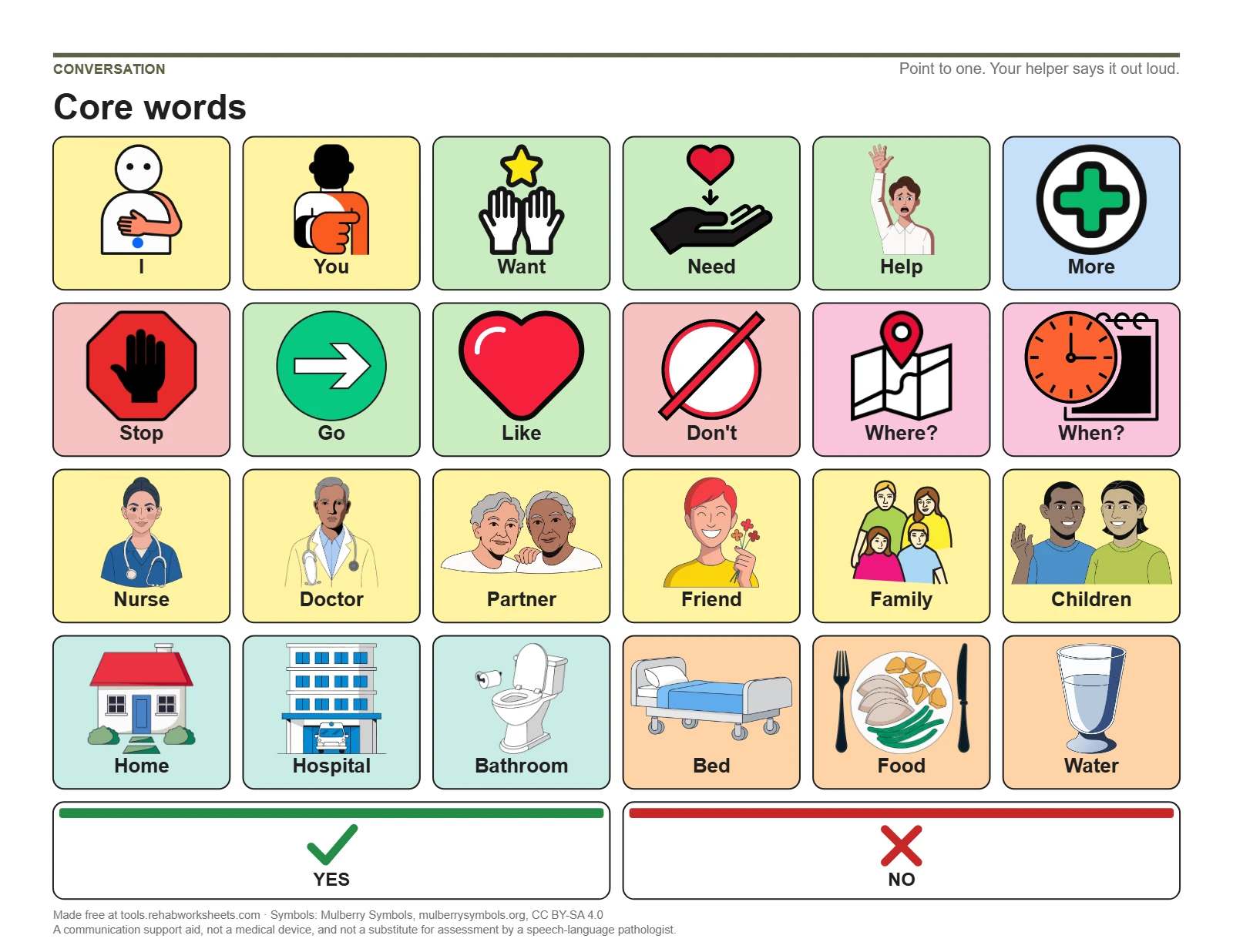
Letter size, 1.2 MB. Print at 100%, not scaled to fit. No sign-in and no email. A4, a second language and your own photos are in the board maker.
What is on the board
6 by 4 squares, with Yes and No along the bottom.
- I · You · Want · Need · Help · More
- Stop · Go · Like · Don't · Where? · When?
- Nurse · Doctor · Partner · Friend · Family · Children
- Home · Hospital · Bathroom · Bed · Food · Water
Who it suits
An adult with aphasia after a stroke or brain injury, and the people who talk with them every day.
For the helper: put on their glasses and hearing aids, say the board title out loud, wait while the person points, say the word out loud, and confirm with Yes or No.
Common questions
What are core words?
A small set of words that carry most everyday messages: I, you, want, need, help, more, stop, go, like, don't, where and when. With a few people and places added, two or three of them make a message by pointing.
Why the colours?
The squares use the Fitzgerald key common on communication boards: people in yellow, actions in green, describing words in blue, things in orange, social words in pink, and stop and don't in red. The colour helps the eye find the kind of word.
Can I use it in French or Spanish?
Yes. Choose English and French or English and Spanish in the board maker, and the second word prints under the first, in italics.
From the book
This board follows pages 80, 81, 82 of Communication Boards for Adults, a large-print paperback of 112 boards with Yes and No on every page. Four of its boards are free to download here, and the whole book is on the store.
Boards made here are designed to support everyday communication between a person and their helpers.
A communication support aid, not a medical device, and not a substitute for assessment by a speech-language pathologist.