
Free printable board
Hospital bedside communication board
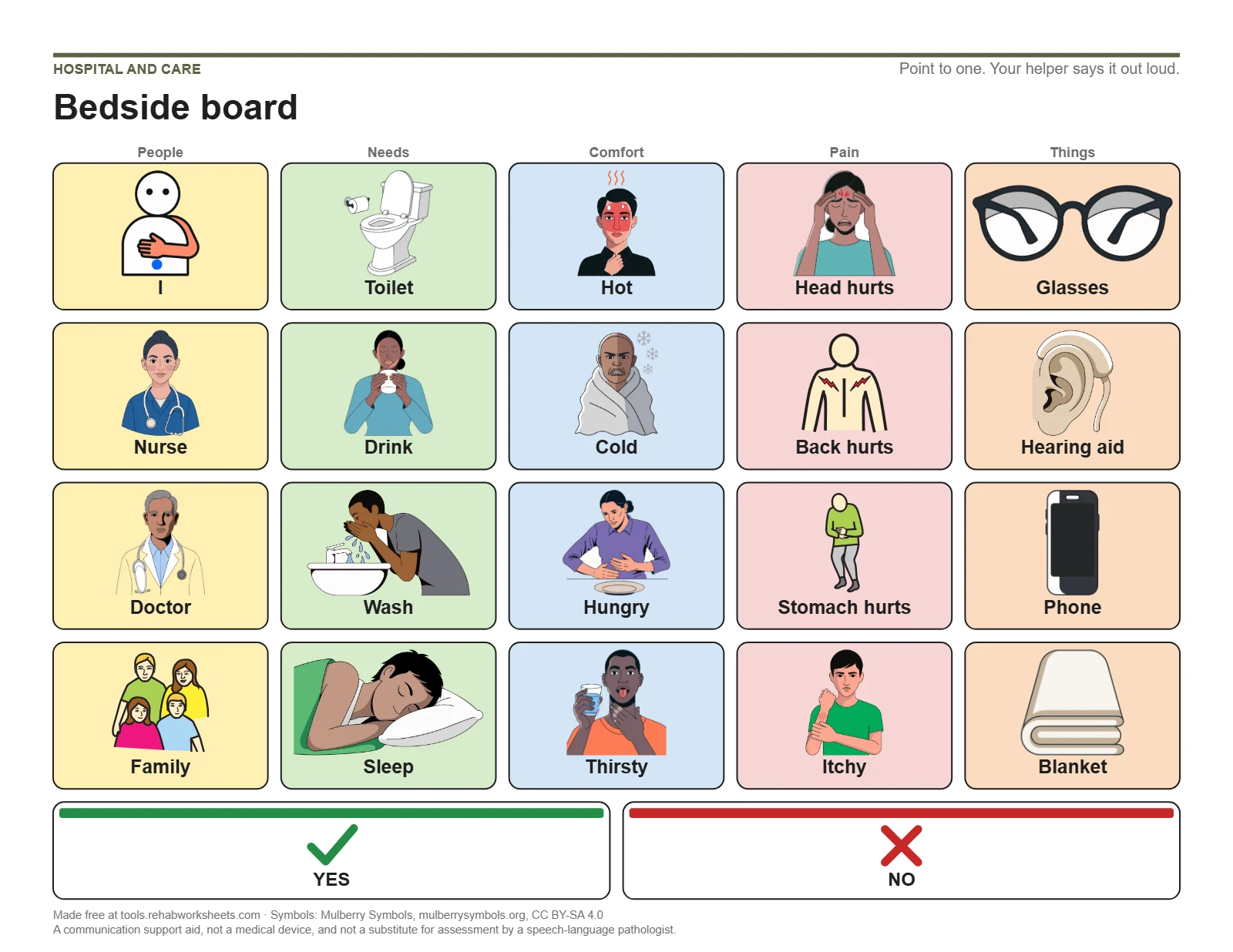
Twenty squares in five columns: people, needs, comfort, pain and things, with Yes and No.
Letter size, 961 KB. Print at 100%, not scaled to fit. No sign-in and no email. A4, a second language and your own photos are in the board maker.
What is on the board
5 by 4 squares, with Yes and No along the bottom.
- I · Toilet · Hot · Head hurts · Glasses
- Nurse · Drink · Cold · Back hurts · Hearing aid
- Doctor · Wash · Hungry · Stomach hurts · Phone
- Family · Sleep · Thirsty · Itchy · Blanket
Who it suits
A patient on a ward and the nurses, family and friends who talk with them through the day.
For the helper: put on their glasses and hearing aids, say the board title out loud, wait while the person points, say the word out loud, and confirm with Yes or No.
Common questions
What is a hospital communication board?
A printed sheet of pictures and words that a patient points to when speaking is hard. This one has five columns, people, needs, comfort, pain and things, with Yes and No at the bottom, so the first things a person needs to say are all on one page.
How do I use it at the bedside?
Put on the person's glasses and hearing aids, hold the board where they can reach or see it, say the title out loud, and wait while they point. Say the word they pointed to out loud and confirm with Yes or No.
Can I add the ward's own words?
Yes. Every square can take a new word, a second language under it, a different picture, or a photo of a person or a place. The column headers can be changed too.
From the book
This board follows pages 14, 24, 26, 48 of Communication Boards for Adults, a large-print paperback of 112 boards with Yes and No on every page. Four of its boards are free to download here, and the whole book is on the store.
Boards made here are designed to support everyday communication between a person and their helpers.
A communication support aid, not a medical device, and not a substitute for assessment by a speech-language pathologist.